Section outline

  • The writing phase includes the precise structure of written work and the design of the sections and components to be written. In addition, the topic of language and writing style is addressed in sub-chapter 5.2. All written work carried out at the UAS Grisons need to comply with the here defined standards.

    • Chapter 5.1 Structure of a written work

      The central part of a scientific paper is the text part, consisting of introduction, main part, and a conclusion. This is where the actual topic is dealt with. However, the introduction and conclusion, in particular the title page and credits, are also part of the text. The individual parts occur in a specific order. The parts and sequences defined in column “Basic requirements” of the table below apply at minimum to all written work created at the UAS Grisons. These requirements apply, for example – though not exclusively – to text types such as practice-oriented formats (project work and commissioned reports), technical reports, product or project documentation, and essays. A distinction is also made between coursework and the final thesis. The following table provides information on the structure of the parts and sequences sections, whether they meet the basic requirements, and whether they feature in coursework or the final thesis:

      Table 2: Structure of written work
      Sections Parts and sequence Basic requirements Coursework Thesis Page number format
      Opening credits Title page optional yes yes without page number
      Abstract no optional yes roman, beginning with I
      Preface no no optional roman
      Table of contents optional yes yes roman
      List of figures, tables, abbreviations optional yes yes roman
      Text part Text part including
      • Introduction
      • Main Part
      • Conclusion
      yes yes yes arabic, beginning with 1
      Credits Reference List yes yes yes arabic
      List of aids yes yes yes arabic
      Research protocol recommended recommended recommended arabic
      Appendix optional if present if present arabic
      Declaration of own work yes yes yes without page number
    • Chapter 5.1.1 Opening Credits

      Title Page
      Sample title page can be found in Appendix A (coursework) and Appendix B (degree thesis). The title should precisely and meaningfully reflect the core aspect of the thesis. The logo of the UAS Grisons must not be used on the cover sheet or in the degree thesis.

      Abstract
      The abstract summarises the work in a compact form and enables a quick overview of its content. It describes the research question or objective, the theoretical foundations, the methodological approach, as well as the key findings of the work. The abstract contains no new information, evaluations, or interpretations, but restricts itself to the factual summary of the contents and findings of the work (Goldenstein et al., 2018, p. 69). In the case of the text type commissioned work a management summary is provided instead of an abstract. The abstract should not exceed half a page.

      Preface
      A preface is only customary for more extensive papers. Statements on personal motivation, scientific suggestions, supervision, and acknowledgements are formulated here.

      Table of contents
      The Table of contents reflects the structure and logical composition of the work. It serves as a guide and provides an overview of the outline and individual components of the work. Chapter titles should be formulated precisely, clearly, and consistently to the work’s content (Goldenstein et al., 2018, pp. 139–140). A common thread should be discernible form the table of contents. The chapters and subchapters must be built on one another and be aligned with answering the research question. Besides the chapters and subchapters all other lists, the bibliography as well as the appendix are presented in the table of contents. The declaration of own work is not listed in the table of contents.

      List of figures, tables, and abbreviations
      A separate directory must be created for each of the figures and tables. These dictionaries provide an overview of all figures and tables shown. The list of abbreviations resolves the abbreviations used in the text. The first time, abbreviations are mentioned in the text, they are written out in full, followed by the abbreviation in parentheses. Not included in the list and written out when used for the first time are commonly used short forms (such as "e.g."), which are included in the dictionary.

    • Chapter 5.1.2 Text part

      The text part presents the core of every coursework, paper or thesis. It serves to address the research question in a systematic and comprehensible manner. It presents and contextualises the findings deduced from the research question. Chapters and subchapters build on one another logically, have meaningful headings, and must be numbered according to their level of hierarchy. Where subchapters are used, at least two subchapters of the same hierarchical level must be listed. The work’s structure, every chapter, every section and statement must make a comprehensible contribution to answering the research question. Content unrelated to the research question is not to be included into the work.

      Written work builds on the current state of knowledge and engages critically with existing findings. The presentation of the state of knowledge is based on scientific literature and, in the case of empirical studies, additionally on primary or secondary data, including the demonstration of the data collecting process. The results are derived in a comprehensible manner, justified, contextualised, and discussed regarding the research question. The following listed elements are to be addressed in the text part (adapted from Heesen, 2021, p. 16):

      Table 3: Content per section
      Section Content Weiterführendes Material
      Introduction Introduction to the addressed problem/topic  
      Research question (incl. theses and hypotheses if needed)  
      Objectives and benefits  
      Main part Methodological approach (distinction between theoretical and empirical work and selection of a quantitative or qualitative research design) See Chapter 2.2, as well as Chapter 8.3 for the responsible use of AI
      State of knowledge See also Chapter 5.1.3 and 8.2
      Presentation and interpretation of the obtained findings  
      Conclusion Summary and discussion of the obtained findings  
      Addressing and answering the research question  
      Reflections on the work incl. its limitations See also Chapter 8.3
      Outlook  
    • Chapter 5.1.3 Credits

      The credits comprise components that serve the documentation, traceability, and completeness of the work. These include the reference list, the list of aids, the research protocol, the appendix, and the declaration of own work.

      Reference List
      The reference list lists all sources used and cited in the work. If a source has not been used (i.e., not quoted/cited verbatim or analogously), it is not listed. The references are listed according to the used citation style. The bibliography creation can be supported by using literature management software. More information about this can be found in Chapter 7.

      List of aids
      The list of aids serves to document all systems, software, and tools that were used in support of the creation process of the presented work. These range from literature management software to statistical tools to AI-based systems (see Chapter 8.2). It must be comprehensible to third parties which systems were used for what purpose and to what extent. These following parts must be documented in the list of aids:

      • Stating the system/software including detailing the exact version
      • Purpose within the paper/work
      • Affected section within the work (chapter and page)

      The required format of the list of aids is demonstrated in this example.

      Research protocol
      To ensure a transparent and traceable research process, it is helpful to create a research protocol according to this template. The protocol documents the research steps carried out as well as the sources considered. The following details are to be provided in the research protocol:

      • Date of the search
      • Name of the tool, platform or system used, or the strategy employed (see Chapter 4.1)
      • Details of the search query
      • Selection criteria
      • Details of the source found and used in the work, including a reference

      Maintaining and submitting a research protocol is recommended but not mandatory and must be explicitly requested.

      Appendix
      The appendix includes additional documents that are relevant for the understanding, traceability, or verification of the work, but would disrupt the (reading) flow of the main text. Statistical evaluations, research schemes or questionnaires, are also inserted at this point.

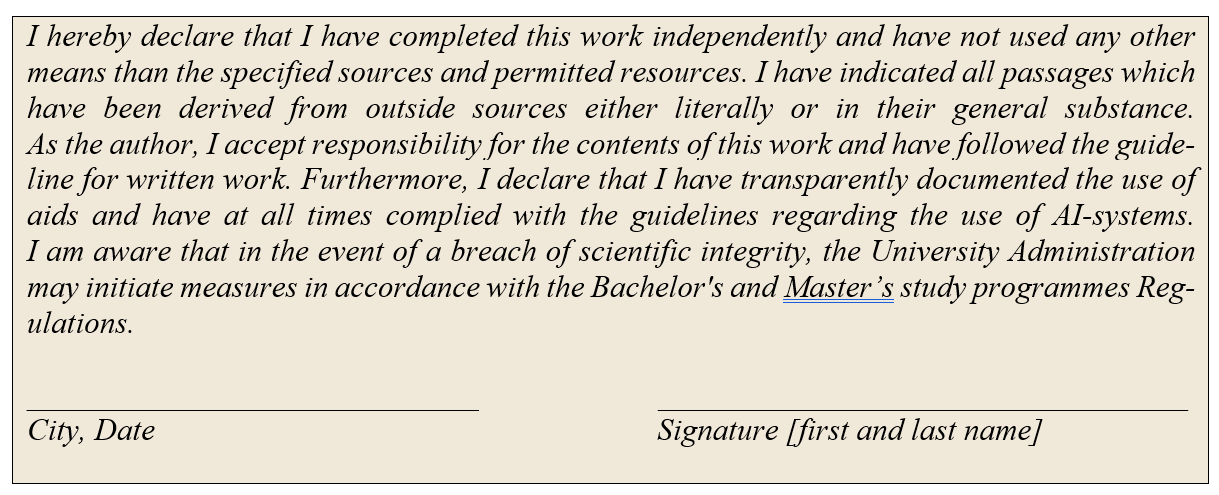
      Declaration of own work
      The declaration of own work is attached to the last page and is not included in the table of contents. The following wording must be used for the declaration of own work:

      Table 4: Declaration of own work

      Screenshot of the Declaration of own work, Original to be found in the PDF.

    • Chapter 5.2 Writing style

      Any written work at the UAS Grisons is characterised by an objective, exact, and comprehensible language. Statements are to be formulated clearly and supported by scientific sources. Evaluative, exaggerated, or colloquial formulations must be avoided. The used terminology is to be defined unambiguously and applied continuously throughout the entire work. Additionally, attention is to be paid to a logically structured argumentation and a comprehensive reading experience. Gender-inclusive language and discrimination-sensitive visual communication is to be applied. The provisions of the Language and Image Guideline of the UAS Grisons applies.

      The use of the first-person singular (I) or plural (we) form is common in the Englisch-speaking scientific world. Especially in the introductory chapter, in connection with the reading guide in the text or in the critical examination of existing knowledge and the creation of new knowledge (Steinhoff, 2007, pp. 169–205). At the UAS Grison this is to be avoided.

      The UAS Grisons Library offers individual writing consultation. This supports questions regarding scientific writing, structuring texts, as well as developing healthy writing habits to overcome writing problems. Information on the offer and registration can be found on the Research Bar.