Abschnittsübersicht

    • The provisions of this guideline are binding for written work in the Bachelor's and Master's study programs at the University of Applied Sciences of the Grisons, in accordance with the corresponding directive. This guideline regulates the fundamental standards for written work. It aims to define requirements to ensure good scientific practice, including university-wide regulations governing the use of AI systems in written work. Furthermore, the guideline provides specifications for the formal design and formatting of written work. Students and instructors of the UAS Grisons consistently adhere to these regulations defined in this guideline when planning and producing coursework, research paper and theses.

      The regulatory framework for coursework and theses is provided in the directive Bachelor's and Master’s study programmes. Any additional subject-specific information (i.e. the scope of the work or product documentation requirements) can be found in the module descriptions or the semester information.

      These guidelines are supervised by the module leader for "scientific writing & AI" and the library team of the UAS Grisons on behalf of the Head of Teaching and Learning. If there are any questions, ambiguities, discrepancies, or comments, the supervising team can be contacted at the following e-mail address: leitfaden@fhgr.ch

    • Authors: Wenke Alberts, Lea Reinhold und Elham Müller
      Issuing authority:   Ressortleitung Lehre
      Scope: Fachhochschule Graubünden
      Version:   V02
      Issuing Date: 01.09.2026

  • Written work at the University of Applied Sciences of the Grisons is to be composed on scientific principles. This means that the systematic and traceable processing of the topic is central. Written work is understood as all texts submitted for performance assessment at the UAS Grisons. In addition to classic scientific research papers and assignments, this includes practice-oriented formats such as project work and commissioned reports, design projects, technical reports, product or project documentation, essays and other types of text. The following sub-chapter 2.1 sets out which regulations of the guideline must, as a minimum, be applied in all written work. Furthermore, the present chapter 2 provides a more detailed definition of academic work and how it is structured in theoretical and empirical studies.

    • Chapter 2.1 Basic standards for all written work

      Regardless of the specific type of text, all written work at the University of Applied Sciences of the Gri-sons must, as a minimum, comply with the standards set out in this chapter.

      Research projects and final theses must, without exception, comply with all the regulations set out in the guideline.

    • Chapter 2.2 Scientific work

      Working scientifically serves the systematic and transparent treatment of (research) questions. Based on the existing knowledge within a discipline, research questions are developed and worked on using appropriate scientific methods. An independent scholarly achievement is central to this process.

      Scientific work is characterised by a critical engagement with the current state of knowledge. A purely descriptive presentation of existing content does not meet the requirements of scientific work. Findings and conclusions must be justified in a comprehensible manner, must be contextualised, and be critically reflected upon.

    • Chapter 2.2.1 Characteristics of scientific work

      Per (Goldenstein et al., 2018, pp. 5–6) scientific work is characterised by several fundamental features. Scientific work pursues a research question in a systematic and method-guided way, ensuring that the approach and the results are presented in a transparent and comprehensive manner. By doing so, it builds on the existing body of scientific knowledge, engages critically with theoretical foundations as well as established findings of the researched field. Furthermore, scholars are said to make an independent contribution to addressing a research question by reflection on, further developing or applying existing knowledge to new contexts.

      Scientific work aims to attain at reliable and robust findings. In empirical studies in particular, the quality criteria objectivity, validity, and reliability are of utmost importance. The presentation of scientific work is carried out in a clear, precise, and accessible language, whilst adhering to consistent formals standards.

    • Chapter 2.2.2 Theoretical and empirical work

      Scientific work can be designed as theoretical or empirical work. The type determines the approach, the methods used, as well as the structure of the work. Regardless, the same requirements of scientific work apply to both types, especially regarding transparency, argumentation, and scientific integrity.

      Theoretical work engages with the existing body of scientific knowledge. Theoretical work analyses, compares, and reflects on scientific literature to answer research questions, identify connections, or to further develop theoretical approaches (Voss, 2024, p. 25).

      Empirical work explores research questions based on self-collected (primary) or existing (secondary) data. At that theoretical assumptions are examined, relationships are investigated, or approaches to solutions are developed and evaluated. Depending on the research question quantitative or qualitative research methods are used (Voss, 2024, p. 25).

  • The planning of every written work starts with the topic and problem definition, and/or a research question. A research proposal serves as a planning device, which summarizes the objectives of the work/paper/thesis.

    • Chapter 3.1 Topic, research question, thesis and hypothesis

      Every written work is based on a topic that is translated into a (research) question. The question defines the object of investigation and determines the direction of the work.

      Depending on the type of work, the question can transform into a research question, from which theses or hypotheses can be deduced. Theses formulate educated/reasoned assumptions or positions that are discussed argumentatively over the course of the work. Hypotheses formulate testable assumptions about relationships or differences and are tested within an empirical investigation.

    • Chapter 3.2 Research proposal

      A research proposal serves the planning and structuring of scientific work. The proposal describes the planned research project and establishes the basis for supervision and subject-specific feedback. As the same time, it helps to review if the topic, the research question, the defined objectives, and the chosen methodology are coherently aligned. Module descriptions or semester information provide information when a research proposal is needed.

      A research proposal contains the following contents:

      Table 1: Content research proposal
      Content Note
      Title page the required elements are listed in Chapter 5.1.1. The title page is presented as per the template found in appendix A. The title should bear the addition “Research Proposal”.
      Introduction

      with introduction to the topic and its relevance

      Research question see Chapter 3.1
      Methodical approach see also Chapter 8.3 for the informed use of AI systems
      State of research summary of the current state of knowledge on the chosen topic
      Structure/outline logical organization, common thread
      Timetable timeline of the project, defined milestones
      Reference list see Chapter 5.1.3 and Chapter 7;. for the proposal the reference list is to be separated in 1. literature used and 2. further reading
      List of aids see Chapter 5.1.3 and 8.2
      Research protocol see Chapter 5.1.3 and 8.2
      Declaration of own work see Chapter 5.1.3

      The length of a research proposal is 4-6 pages (excluding the title page, lists such as table of contents, reference list, or list of aids, and the declaration of own work). The requirements for citation, referencing, formal formatting, language, and layout are identical to those of full written works.

  • The library of the UAS Grisons and its Research-Bar on Moodle is the entry point regarding the source research. It provides access to all kinds of databases, AI-based research tools, as well as the Switzer-land-wide academic library catalogue Swisscovery and provides information on how to efficiently use them. Should the source research not be successful, the library format “Book a Librarian” or the UAS Grisons lecturers are pleased to support in an advisory capacity. All written work carried out at the UAS Grisons are based on a thorough research process, which is outlined in the following sub-chapters (4.1 and 4.2) and described in more detail on the Research-Bar.

    • Chapter 4.1 Research process

      Depending on what subject or what type of publication is searched for, the path to the source is quite different. The library’s Research-Bar provides a good overview of the individual steps of the research process, such as research strategies, the available research platforms, and the organization of relevant sources, including literature management software.

      The basis of each search is the research question and the deduced concepts/terms. With the resulting list of terms, various research strategies can be applicable to find relevant sources. Possible strategies are (adapted form Ridley, 2012, p. 53):

      • Trial and Error: Free search with keywords to narrow down the topic and bring structure into the search.
      • Exchange with experts: Get in touch with experts, professors, and teachers to get literature recommendations.
      • Snowball system: Check reference list and references from relevant publications to find more interesting resources.
      • Systematic research by themes: Split the topic into subtopics to search for them separately and join them together later.

      The exact research process can be documented in a research protocol and listed in the appendix (see Chapter 5.1.3 and 8.2). How many sources are required to be referenced, differentiates between type of work (theoretical vs. empirical, coursework/research paper/thesis). A generalized answer is not possible.

    • Chapter 4.2 Source evaluation

      Every written work presents strong arguments which are conclusive and comprehensible. These factual conditions originate from data sources. Data sources can vary in quality and require to be evaluated based on different criteria. A general checklist can be found under this link.

      The Journal Impact Factor or, in the case of open access journals, the DOAJ platform can help with the assessment of scientific journals. It should also be ensured that the journal has a transparent peer re-view process. In addition to academic journals, there are also non-academic journals.

      Attention is required for outputs from generative AI systems. These cannot be included in the work, i.e. they are not worthy of citation. The exceptions to this rule as well as the specific handling of all types of AI systems in the context of written work are defined in Chapter 8 of this guideline.

  • The writing phase includes the precise structure of written work and the design of the sections and components to be written. In addition, the topic of language and writing style is addressed in sub-chapter 5.2. All written work carried out at the UAS Grisons need to comply with the here defined standards.

    • Chapter 5.1 Structure of a written work

      The central part of a scientific paper is the text part, consisting of introduction, main part, and a conclusion. This is where the actual topic is dealt with. However, the introduction and conclusion, in particular the title page and credits, are also part of the text. The individual parts occur in a specific order. The parts and sequences defined in column “Basic requirements” of the table below apply at minimum to all written work created at the UAS Grisons. These requirements apply, for example – though not exclusively – to text types such as practice-oriented formats (project work and commissioned reports), technical reports, product or project documentation, and essays. A distinction is also made between coursework and the final thesis. The following table provides information on the structure of the parts and sequences sections, whether they meet the basic requirements, and whether they feature in coursework or the final thesis:

      Table 2: Structure of written work
      Sections Parts and sequence Basic requirements Coursework Thesis Page number format
      Opening credits Title page optional yes yes without page number
      Abstract no optional yes roman, beginning with I
      Preface no no optional roman
      Table of contents optional yes yes roman
      List of figures, tables, abbreviations optional yes yes roman
      Text part Text part including
      • Introduction
      • Main Part
      • Conclusion
      yes yes yes arabic, beginning with 1
      Credits Reference List yes yes yes arabic
      List of aids yes yes yes arabic
      Research protocol recommended recommended recommended arabic
      Appendix optional if present if present arabic
      Declaration of own work yes yes yes without page number
    • Chapter 5.1.1 Opening Credits

      Title Page
      Sample title page can be found in Appendix A (coursework) and Appendix B (degree thesis). The title should precisely and meaningfully reflect the core aspect of the thesis. The logo of the UAS Grisons must not be used on the cover sheet or in the degree thesis.

      Abstract
      The abstract summarises the work in a compact form and enables a quick overview of its content. It describes the research question or objective, the theoretical foundations, the methodological approach, as well as the key findings of the work. The abstract contains no new information, evaluations, or interpretations, but restricts itself to the factual summary of the contents and findings of the work (Goldenstein et al., 2018, p. 69). In the case of the text type commissioned work a management summary is provided instead of an abstract. The abstract should not exceed half a page.

      Preface
      A preface is only customary for more extensive papers. Statements on personal motivation, scientific suggestions, supervision, and acknowledgements are formulated here.

      Table of contents
      The Table of contents reflects the structure and logical composition of the work. It serves as a guide and provides an overview of the outline and individual components of the work. Chapter titles should be formulated precisely, clearly, and consistently to the work’s content (Goldenstein et al., 2018, pp. 139–140). A common thread should be discernible form the table of contents. The chapters and subchapters must be built on one another and be aligned with answering the research question. Besides the chapters and subchapters all other lists, the bibliography as well as the appendix are presented in the table of contents. The declaration of own work is not listed in the table of contents.

      List of figures, tables, and abbreviations
      A separate directory must be created for each of the figures and tables. These dictionaries provide an overview of all figures and tables shown. The list of abbreviations resolves the abbreviations used in the text. The first time, abbreviations are mentioned in the text, they are written out in full, followed by the abbreviation in parentheses. Not included in the list and written out when used for the first time are commonly used short forms (such as "e.g."), which are included in the dictionary.

    • Chapter 5.1.2 Text part

      The text part presents the core of every coursework, paper or thesis. It serves to address the research question in a systematic and comprehensible manner. It presents and contextualises the findings deduced from the research question. Chapters and subchapters build on one another logically, have meaningful headings, and must be numbered according to their level of hierarchy. Where subchapters are used, at least two subchapters of the same hierarchical level must be listed. The work’s structure, every chapter, every section and statement must make a comprehensible contribution to answering the research question. Content unrelated to the research question is not to be included into the work.

      Written work builds on the current state of knowledge and engages critically with existing findings. The presentation of the state of knowledge is based on scientific literature and, in the case of empirical studies, additionally on primary or secondary data, including the demonstration of the data collecting process. The results are derived in a comprehensible manner, justified, contextualised, and discussed regarding the research question. The following listed elements are to be addressed in the text part (adapted from Heesen, 2021, p. 16):

      Table 3: Content per section
      Section Content Weiterführendes Material
      Introduction Introduction to the addressed problem/topic  
      Research question (incl. theses and hypotheses if needed)  
      Objectives and benefits  
      Main part Methodological approach (distinction between theoretical and empirical work and selection of a quantitative or qualitative research design) See Chapter 2.2, as well as Chapter 8.3 for the responsible use of AI
      State of knowledge See also Chapter 5.1.3 and 8.2
      Presentation and interpretation of the obtained findings  
      Conclusion Summary and discussion of the obtained findings  
      Addressing and answering the research question  
      Reflections on the work incl. its limitations See also Chapter 8.3
      Outlook  
    • Chapter 5.1.3 Credits

      The credits comprise components that serve the documentation, traceability, and completeness of the work. These include the reference list, the list of aids, the research protocol, the appendix, and the declaration of own work.

      Reference List
      The reference list lists all sources used and cited in the work. If a source has not been used (i.e., not quoted/cited verbatim or analogously), it is not listed. The references are listed according to the used citation style. The bibliography creation can be supported by using literature management software. More information about this can be found in Chapter 7.

      List of aids
      The list of aids serves to document all systems, software, and tools that were used in support of the creation process of the presented work. These range from literature management software to statistical tools to AI-based systems (see Chapter 8.2). It must be comprehensible to third parties which systems were used for what purpose and to what extent. These following parts must be documented in the list of aids:

      • Stating the system/software including detailing the exact version
      • Purpose within the paper/work
      • Affected section within the work (chapter and page)

      The required format of the list of aids is demonstrated in this example.

      Research protocol
      To ensure a transparent and traceable research process, it is helpful to create a research protocol according to this template. The protocol documents the research steps carried out as well as the sources considered. The following details are to be provided in the research protocol:

      • Date of the search
      • Name of the tool, platform or system used, or the strategy employed (see Chapter 4.1)
      • Details of the search query
      • Selection criteria
      • Details of the source found and used in the work, including a reference

      Maintaining and submitting a research protocol is recommended but not mandatory and must be explicitly requested.

      Appendix
      The appendix includes additional documents that are relevant for the understanding, traceability, or verification of the work, but would disrupt the (reading) flow of the main text. Statistical evaluations, research schemes or questionnaires, are also inserted at this point.

      Declaration of own work
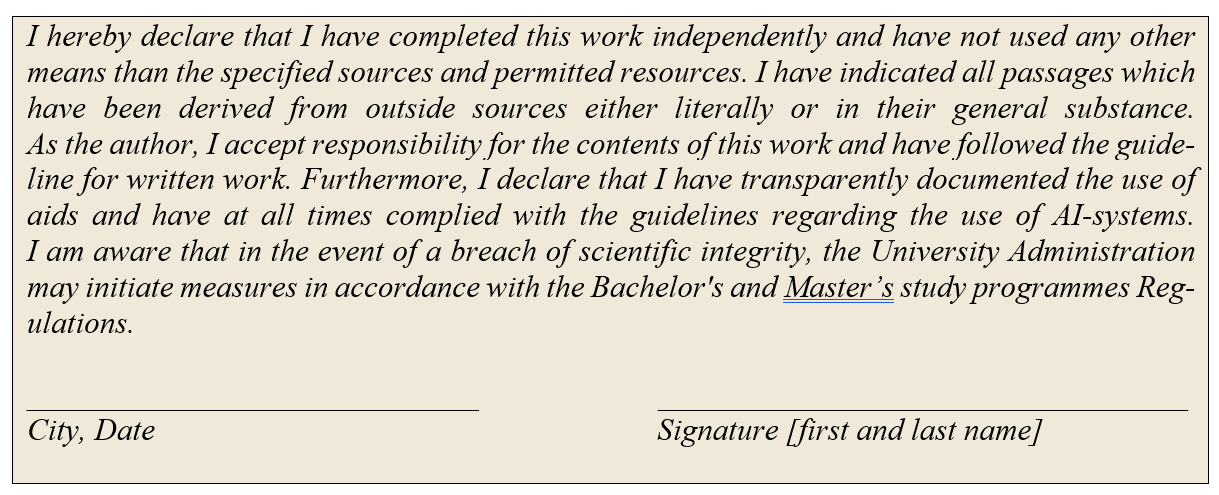
      The declaration of own work is attached to the last page and is not included in the table of contents. The following wording must be used for the declaration of own work:

      Table 4: Declaration of own work

      Screenshot of the Declaration of own work, Original to be found in the PDF.

    • Chapter 5.2 Writing style

      Any written work at the UAS Grisons is characterised by an objective, exact, and comprehensible language. Statements are to be formulated clearly and supported by scientific sources. Evaluative, exaggerated, or colloquial formulations must be avoided. The used terminology is to be defined unambiguously and applied continuously throughout the entire work. Additionally, attention is to be paid to a logically structured argumentation and a comprehensive reading experience. Gender-inclusive language and discrimination-sensitive visual communication is to be applied. The provisions of the Language and Image Guideline of the UAS Grisons applies.

      The use of the first-person singular (I) or plural (we) form is common in the Englisch-speaking scientific world. Especially in the introductory chapter, in connection with the reading guide in the text or in the critical examination of existing knowledge and the creation of new knowledge (Steinhoff, 2007, pp. 169–205). At the UAS Grison this is to be avoided.

      The UAS Grisons Library offers individual writing consultation. This supports questions regarding scientific writing, structuring texts, as well as developing healthy writing habits to overcome writing problems. Information on the offer and registration can be found on the Research Bar.

  • The formal requirements defined in this chapter apply to all written work and text types, concerning layout, fonts and sizes, as well as how to handle illustrations. For text types focusing on creativity and design, the guidelines in chapters 6.1 and 6.2 are not mandatory.

    • Chapter 6.1 Structural format and layout

      The principle of uniformity applies to the format. The following format specifications can serve as a reference:

      • DIN A4 pages, portrait format, double-sided writing
      • Text alignment: justified print, automatic hyphenation
      • Line spacing: 1.3-1.5 (OpenOffice: 130-150%) in the main text, for footnotes line spacing 1
      • Font: Times New Roman
      • 14 pt for level 1 headings
      • 12 pt for text, for level 2 headings and lower, for headings and numbering of tables and figures
      • 12 pt bold for numbering
      • 10 pt for annotations on figures, tables etc., as well as footnotes, page numbering, and in the headers and footers, which may include the title and author
      • Emphasis and special formatting such as bold, italics, etc. are used sparingly
      • For headings, use the font, bold, left-aligned. Up to level 3, headings are included in the table of con-tents. Headings are kept together with the following paragraph and should not stand alone.
      • Page margins: top + right 2.5 cm, bottom 2 cm and left 3 cm from the page margin. The header should have 1.3 cm from the page margin.
      • Page numbering: footer, right-justified, numbering starts with the page of the introduction in Arabic numerals. The pages before that are numbered in Roman numerals. Roman numeration starts after the title page (see Table 2).
      • A paragraph is to be regarded as a unit of meaning. It should be no shorter than three sentences and no longer than one page. The introductory sentence refers to the ideas described in the paragraph.
      • Numbers up to one hundred are to be spelled out.
      • The UAS Grisons Logo must not be used on title pages or anywhere else in the work.

      These requirements do not necessarily apply to written work focusing on creativity and design.

    • Chapter 6.2 Figures and tables

      Figures and tables (also referred to as illustrations) serve to visualise data, facts, or relationships. They are primarily used when a presentation in the text would be too complicated and difficult to read. Illustra-tions must be numbered and listed in the list of figures or tables. The text must refer to them with reference to the corresponding number (e.g., "As shown in Figure 3 …"). Furthermore, figures and tables should always be commented, regardless of whether they appear in the main text or in the appendix. However, figures and tables should be used sparingly in the work. The format for embedding and labelling figures and tables must be applied consistently throughout the work and depends on the citation style used (see Chapter 7).

      These requirements do not necessarily apply to written work focusing on creativity and design.

  • Good scientific practice is characterised, among other things, by the fact that reference is made to terms, thoughts, results, concepts, and models of other authors. In the case of partial or complete adoption of "foreign" information, the authorship must always be stated. This applies to verbatim quotations, paraphrases, summaries, translations as well as figures and tables. Failure to indicate the source is a violation of scientific integrity. This violation is also called plagiarism. This is an act of deception and is graded with a mark of 1.0 in accordance with the Bachelor's and Master’s study programmes Regulations.

    The adoption of foreign ideas must always be documented and identified by a suitable reference in all written work penned at the UAS Grisons. This means that source references for information taken over verbatim and correspondingly are integrated directly into the text. This is called "citing". The citation can also be used to locate the detailed source.

    At the UAS Grisons the APA (American Psychological Association) citation style is used. These citation standards are widely established beyond psychological and social science literature. For written work the 7th edition of APA is currently in use.

    In technical disciplines and degree programmes, in the case of the UAS Grisons particularly at the Institute Photonics and Robotics (IPR), the citation style of the Institute of Electrical and Electronics Engineers (IEEE) is used, which is based on a numeric referencing system.

    The reference list contains all sources used and cited in the work. Sources that are not referenced are not included. Entries are created in accordance with the specifications of the required citation style. The creation of the in-text-citations and the bibliographic references can be supported by common literature management software.

    Personal forms of communication (conversations, letters, emails, etc.) belong in the appendix if a reference is necessary and need to be referenced according to the citation style standards.

    • Chapter 7.1 APA

      With APA a distinction is made between direct citation (the verbatim adoption of third-party intellectual content, also referred to as a direct quotation) and indirect citation (the substantive adoption of third-party intellectual content, also referred to as a paraphrase). Direct quotations should be used sparingly and only where no paraphrase is possible or where the exact wording is necessary for understanding.

      The document containing examples of citation and referencing in APA (7th edition) can be found at this link.

    • Chapter 7.2 IEEE

      The document containing examples of citation and referencing in IEEE can be found at this link (only available in German).

  • Artificial Intelligence (AI) refers to machines designed to mimic human intelligence. This includes per example generative AI tools (abbr. GEN AI), which can independently generate texts, illustrations or music, as well as agentic AI (AI Agents), which perform tasks on their own. Regardless of the type AI based systems may be used in the context of written work at the UAS Grisons. For example, to generate ideas or improve one’s own text (spelling correction, formulation help). AI systems can also be helpful in the research process.

    The binding requirements for the use of artificial intelligence systems in all written work/papers at the UAS Grisons are regulated in the following chapters.

    • Chapter 8.1 Content responsibility

      Written work is to be created independently and must comply with the rules of good scientific practice. This means

      • the author is responsible for all parts of the work.
      • the work is based in its essential aspects on the thoughts and ideas of the author.
    • Chapter 8.2 Transparency

      Any use of AI systems must be documented in the List of aids. It must be comprehensible to third parties which systems were used to what purpose and to what extent. Further, it should be noted that not only AI based systems need to be listed in the list of aids (e.g., survey tools such as LimeSurvey or literature management with Zotero).

      Should the submitting of a research protocol be requested, the intended use of the AI system must be examined carefully. If an AI system is used, for example, for identifying a research gap or to gain inspiration on text structuring, it will be listed in the list of aids. However, if an AI system is used for research (even for only one instance), it is not to be documented in the list of aids, but in the research protocol.

      Should no research protocol be required, all tools, regardless of their purpose of use, are listed in the list of aids.

      What details are to be listed in the list of aids, or the research protocol can be found in Chapter 5.1.3 of this guideline.

    • Chapter 8.3 Reflective AI use

      To make the responsible usage of AI systems more visible, a two-stage confrontation is required in every written work, in addition to the formats in Chapter 8.2. This confrontation is only required when AI systems were used in the creation process of the presented work.

      • On the one hand, in the methodological approach section of the main part is to describe which AI systems were used. The specific function (e.g., idea generation, transcription, or data analysis etc.) of the AI system in the research process must be explained.
      • On the other hand, the methodological use of AI systems is to be critically evaluated in the reflection (see Chapter 5.1.2). It is to be discussed to what extent the use of AI systems was effective for completing the task and where the limits of machine assistance have become clear. Based on this insight, an outlook on the completion of future tasks is to be deduced.

      The PAIR framework of King’s College serves as the basis for this two-stage reflection.

    • Chapter 8.4 Citation Worthiness

      AI systems are not worthy to be cited in written papers. However, three exceptions apply for generative AI systems.

      • For figures and graphics created with generative AI tools and used in the work, it must be explained within the heading that it is an original representation created with the help of AI. The specific AI model is mentioned in the subsequent source citation, including the reference in the reference list and inclusion in the list of aids.
      • If the author sees it fit to include the output of a prompt (question to a chatbot) without significant intellectual effort (without significant own contribution means that the contents/texts taken over analogously do not originate from one's own knowledge or thoughts), this must be marked with an in-text-reference (e.g. OpenAi, 2023a) and listed with the corresponding reference in the reference list. If this is not done, it constitutes plagiarism. This is an act of deception and is graded with a mark of 1.0 in accordance with the Bachelor's and Master’s study programmes Regulations. For purposes of traceability, the use must also be listed in the list of aids including a remark explaining why the author decided to directly adopt the output.
      • A direct (verbatim) adoption of text outputs from generative AI systems is only allowed if these were used only as formulation and spelling aid (optimisation of self-written content). Further, the adoption is allowed if research questions, these, text fragments were developed with the help of AI and subsequently checked, improved, and adapted by the author themselves. Direct adoption does not need to be marked as a citation, but the use of AI system must be listed in the list of aids.
    • Chapter 8.5 Copyright and data protection

      Copyrighted documents (e.g., PDF articles from databases or the library) or confidential documents (e.g., personal data on interview participants) must not be uploaded to AI tools. Uploading such documents may constitute in a violation of copyright, license agreements, or data protection, and needs to be examined carefully for each case (e.g. technical circumstances, licences such as open access, explicit consent of interview partners, and FADP or GDPR). Further information can be found in the Factsheet on the Use of Generative Artificial Intelligence Applications and in the Overview on the Use of Full Texts in Generative AI of the ETH Zurich.

    • Goldenstein, J., Hunoldt, M., & Walgenbach, P. (2018). Wissenschaftliche(s) Arbeiten in den Wirtschaftswissenschaften. Springer Fachmedien Wiesbaden. https://doi.org/10.1007/978-3-658-20345-0

      Heesen, J. (2021). Informationsethik. In A. Grunwald & R. Hillerbrand (Eds), Handbuch Technikethik (pp. 219–223). J.B. Metzler. https://doi.org/10.1007/978-3-476-04901-8_42

      Ridley, D. (2012). The literature review: A step-by-step guide for students (2. rev. ed). SAGE.

      Steinhoff, T. (2007). Wissenschaftliche Textkompetenz: Sprachgebrauch und Schreibentwicklung in wissenschaftlichen Texten von Studenten und Experten. Max Niemeyer Verlag. https://doi.org/10.1515/978311097338

      Voss, R. P. D. (2024). Wissenschaftliches Arbeiten: ... Leicht verständlich! (9th, Revised, Enlarged ed. edns). utb GmbH. https://doi.org/10.36198/9783838588322

  • These guidelines are supervised and published by the module leader for academic work and the library team of the UAS Grisons.

    If you have any questions, ambiguities, discrepancies or comments, you can contact the supervising team at the following e-mail address: leitfaden@fhgr.ch