
Guidelines for written work at the UAS Grisons
Section outline
-
Written work at the University of Applied Sciences of the Grisons is to be composed on scientific principles. This means that the systematic and traceable processing of the topic is central. Written work is understood as all texts submitted for performance assessment at the UAS Grisons. In addition to classic scientific research papers and assignments, this includes practice-oriented formats such as project work and commissioned reports, design projects, technical reports, product or project documentation, essays and other types of text. The following sub-chapter 2.1 sets out which regulations of the guideline must, as a minimum, be applied in all written work. Furthermore, the present chapter 2 provides a more detailed definition of academic work and how it is structured in theoretical and empirical studies.
-
The planning of every written work starts with the topic and problem definition, and/or a research question. A research proposal serves as a planning device, which summarizes the objectives of the work/paper/thesis.
-
The library of the UAS Grisons and its Research-Bar on Moodle is the entry point regarding the source research. It provides access to all kinds of databases, AI-based research tools, as well as the Switzer-land-wide academic library catalogue Swisscovery and provides information on how to efficiently use them. Should the source research not be successful, the library format “Book a Librarian” or the UAS Grisons lecturers are pleased to support in an advisory capacity. All written work carried out at the UAS Grisons are based on a thorough research process, which is outlined in the following sub-chapters (4.1 and 4.2) and described in more detail on the Research-Bar.
-
The writing phase includes the precise structure of written work and the design of the sections and components to be written. In addition, the topic of language and writing style is addressed in sub-chapter 5.2. All written work carried out at the UAS Grisons need to comply with the here defined standards.
-
Chapter 5.1.3 Credits
The credits comprise components that serve the documentation, traceability, and completeness of the work. These include the reference list, the list of aids, the research protocol, the appendix, and the declaration of own work.
Reference List
The reference list lists all sources used and cited in the work. If a source has not been used (i.e., not quoted/cited verbatim or analogously), it is not listed. The references are listed according to the used citation style. The bibliography creation can be supported by using literature management software. More information about this can be found in Chapter 7.List of aids
The list of aids serves to document all systems, software, and tools that were used in support of the creation process of the presented work. These range from literature management software to statistical tools to AI-based systems (see Chapter 8.2). It must be comprehensible to third parties which systems were used for what purpose and to what extent. These following parts must be documented in the list of aids:- Stating the system/software including detailing the exact version
- Purpose within the paper/work
- Affected section within the work (chapter and page)
The required format of the list of aids is demonstrated in this example.
Research protocol
To ensure a transparent and traceable research process, it is helpful to create a research protocol according to this template. The protocol documents the research steps carried out as well as the sources considered. The following details are to be provided in the research protocol:- Date of the search
- Name of the tool, platform or system used, or the strategy employed (see Chapter 4.1)
- Details of the search query
- Selection criteria
- Details of the source found and used in the work, including a reference
Maintaining and submitting a research protocol is recommended but not mandatory and must be explicitly requested.
Appendix
The appendix includes additional documents that are relevant for the understanding, traceability, or verification of the work, but would disrupt the (reading) flow of the main text. Statistical evaluations, research schemes or questionnaires, are also inserted at this point.Declaration of own work
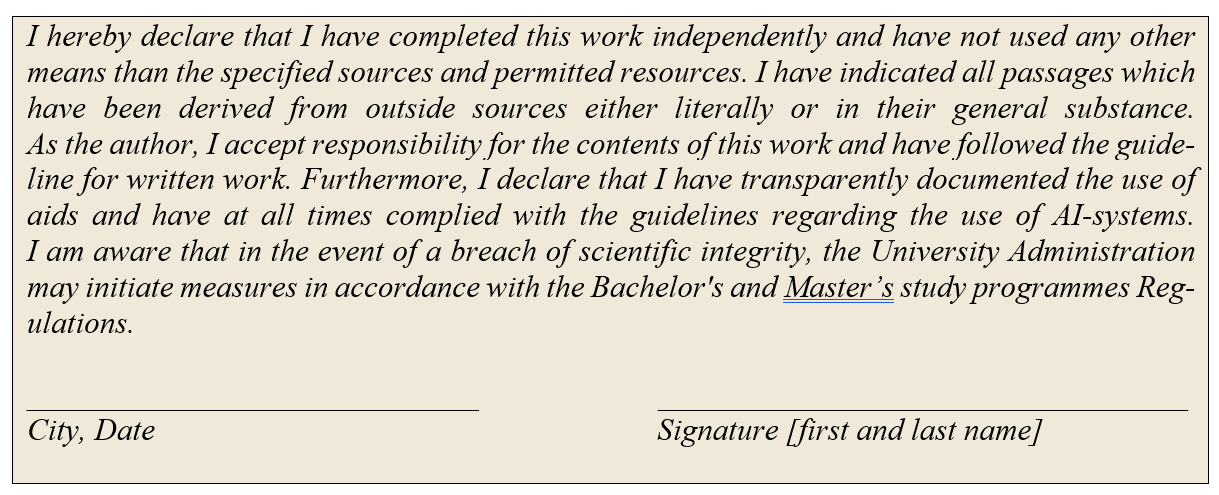
The declaration of own work is attached to the last page and is not included in the table of contents. The following wording must be used for the declaration of own work:Table 4: Declaration of own work
-
The formal requirements defined in this chapter apply to all written work and text types, concerning layout, fonts and sizes, as well as how to handle illustrations. For text types focusing on creativity and design, the guidelines in chapters 6.1 and 6.2 are not mandatory.
-
Good scientific practice is characterised, among other things, by the fact that reference is made to terms, thoughts, results, concepts, and models of other authors. In the case of partial or complete adoption of "foreign" information, the authorship must always be stated. This applies to verbatim quotations, paraphrases, summaries, translations as well as figures and tables. Failure to indicate the source is a violation of scientific integrity. This violation is also called plagiarism. This is an act of deception and is graded with a mark of 1.0 in accordance with the Bachelor's and Master’s study programmes Regulations.
The adoption of foreign ideas must always be documented and identified by a suitable reference in all written work penned at the UAS Grisons. This means that source references for information taken over verbatim and correspondingly are integrated directly into the text. This is called "citing". The citation can also be used to locate the detailed source.
At the UAS Grisons the APA (American Psychological Association) citation style is used. These citation standards are widely established beyond psychological and social science literature. For written work the 7th edition of APA is currently in use.
In technical disciplines and degree programmes, in the case of the UAS Grisons particularly at the Institute Photonics and Robotics (IPR), the citation style of the Institute of Electrical and Electronics Engineers (IEEE) is used, which is based on a numeric referencing system.
The reference list contains all sources used and cited in the work. Sources that are not referenced are not included. Entries are created in accordance with the specifications of the required citation style. The creation of the in-text-citations and the bibliographic references can be supported by common literature management software.
Personal forms of communication (conversations, letters, emails, etc.) belong in the appendix if a reference is necessary and need to be referenced according to the citation style standards.
-
Artificial Intelligence (AI) refers to machines designed to mimic human intelligence. This includes per example generative AI tools (abbr. GEN AI), which can independently generate texts, illustrations or music, as well as agentic AI (AI Agents), which perform tasks on their own. Regardless of the type AI based systems may be used in the context of written work at the UAS Grisons. For example, to generate ideas or improve one’s own text (spelling correction, formulation help). AI systems can also be helpful in the research process.
The binding requirements for the use of artificial intelligence systems in all written work/papers at the UAS Grisons are regulated in the following chapters.
-
-
-
These guidelines are supervised and published by the module leader for academic work and the library team of the UAS Grisons.
If you have any questions, ambiguities, discrepancies or comments, you can contact the supervising team at the following e-mail address: leitfaden@fhgr.ch

